Introduction
Outbound outreach inside large organizations is rarely about speed alone. Especially in traditional industries such as retail, consumer goods, or supply-chain-driven businesses, outreach is often constrained by brand sensitivity, regional complexity, and internal compliance expectations.
For a global company operating in the retail industry, outbound prospecting typically serves very specific goals: identifying strategic partners, engaging suppliers, exploring enterprise sales opportunities, or initiating conversations with regional distributors. In such environments, aggressive automation can be counterproductive. What matters instead is consistency, professionalism, and control.
This article explores a realistic use case for Alsona in such a context. Rather than focusing on abstract features, it walks through how a globally distributed retail organization might use Alsona to systemize outbound outreach while preserving human oversight and brand integrity.
The example is fictional but grounded in common enterprise realities.
The Context: Outbound in a Global Retail Environment
Consider, for example, a global retail organization with operations across North America, Europe, and Asia-Pacific. The company is mature, brand-conscious, and operates at scale. Its outbound needs are not transactional; they are strategic.
Typical outbound objectives might include:
- Engaging regional distributors or franchise partners
- Initiating conversations with technology vendors or logistics partners
- Supporting enterprise sales teams exploring B2B retail solutions
- Running controlled outreach from corporate or regional business development teams
Outbound activity in such organizations is often handled by small, centralized teams rather than high-volume SDR functions. These teams are accountable not only for results but also for how outreach reflects on the brand.
The Job to Be Done
In this scenario, the job-to-be-done can be summarized as
Enable structured, repeatable outbound outreach across LinkedIn and email, without compromising brand reputation, regional sensitivity, or platform compliance.
Key constraints include:
- Outreach must appear intentional and human
- Messaging must remain consistent across regions
- Volume must stay within conservative limits
- Automation should stop once a real conversation begins
This is precisely the type of problem Alsona is designed to address.
Why Alsona Fits This Use Case
Alsona is not built for high-frequency outbound. Its strengths lie elsewhere:
- Predictable workflows
- Controlled pacing
- Minimal operational overhead
- Clear separation between automation and manual engagement
For a global retail organization, these characteristics align well with internal governance and risk considerations.
Step-by-Step: How Alsona Would Be Used in Practice
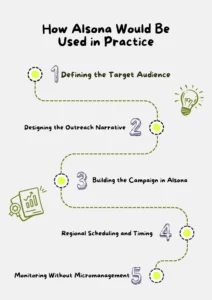
Step 1: Defining the Target Audience
In our example, the outbound team begins by defining a narrow, high-quality target list.
This might include:
- Senior procurement leaders at regional retail chains
- Decision-makers at logistics or fulfilment partners
- Executives at technology vendors relevant to retail operations
The list is curated manually or sourced from internal research teams. Alsona is not used for lead discovery; it is used for outreach execution.
This separation of responsibilities ensures that automation amplifies intent rather than replacing judgment.
Step 2: Designing the Outreach Narrative
Before any automation is configured, the team aligns on messaging.
Key characteristics of the messaging:
- Neutral, professional tone
- No sales-heavy language
- Clear reason for outreach
- Contextual relevance to the recipient’s role or region
For example:
- A short connection message referencing industry alignment
- A follow-up message outlining a potential collaboration area
- An email providing additional context, not pressure
Alsona does not generate messaging automatically by default. This encourages teams to invest in message quality upfront.
Step 3: Building the Campaign in Alsona
With the narrative defined, the team builds a campaign inside Alsona.
A typical workflow might look like this:
- Visit profile
- Wait 2 days
- Send connection request with short context
- Wait 4 days
- Send follow-up message if connected
- Wait 5 days
- Send email with additional information
Each step is deliberately spaced. Daily action limits are kept conservative, reflecting the organization’s risk tolerance.
Step 4: Regional Scheduling and Timing
Because the organization operates globally, timing matters.
Alsona’s cloud-based execution allows campaigns to:
- Run independently of local machines
- Be scheduled according to recipient time zones
- Maintain consistent pacing across regions
This is particularly useful for teams managing outreach across continents without operating 24/7.
Step 5: Monitoring Without Micromanagement
One of the advantages of Alsona in this use case is low-touch monitoring.
Once campaigns are live:
- They do not require constant supervision
- There are few unexpected behaviors.
- Adjustments are infrequent and deliberate
This suits teams that operate alongside many other responsibilities and cannot dedicate full-time resources to outbound operations.
Handling Responses: Where Automation Stops
When a recipient responds, whether on LinkedIn or via email, Alsona effectively steps aside.
The conversation appears in the unified inbox, where:
- Automation pauses for that contact
- A human takes over the conversation
- Context from previous steps is visible
This transition is crucial in enterprise environments, where automated follow-ups during an active conversation would be unacceptable.
Governance and Brand Safety Considerations
For a global retail organization, brand safety is not optional.
Alsona supports governance indirectly by:
- Enforcing daily action limits
- Making workflows transparent and auditable
- Reducing the temptation to over-automate
Campaigns can be reviewed internally before activation, and because the structure is simple, stakeholders can understand exactly what will happen.
Internal Collaboration and Accountability
Although Alsona is often used by individuals or small teams, it supports internal accountability through:
- Clear campaign ownership
- Centralised inbox management
- Predictable campaign behaviour
In the example organization, this allows:
- Corporate oversight of regional outreach
- Consistent messaging across teams
- Easier reporting on outbound activity
Measuring Success in This Use Case
Success metrics in this scenario are not purely volume-based.
Instead, the organisation evaluates:
- Quality of conversations initiated
- Relevance of responses
- Time saved compared to manual outreach
- Absence of platform warnings or account issues
Alsona’s restrained approach supports these metrics by prioritizing stability over scale.
What This Use Case Does Not Require
It is equally important to note what this scenario does not require:
- Complex branching logic
- Automated scoring or prioritisation
- High-frequency message testing
- Deep CRM analytics
For those needs, other tools might be more appropriate. Alsona succeeds here precisely because it avoids unnecessary complexity.
Potential Limitations in This Context
No tool is without trade-offs.
In this use case, Alsona may feel limiting if:
- The organisation later decides to scale outbound dramatically
- Multiple teams require advanced coordination within one platform
- CRM-driven automation becomes a priority
However, these are strategic decisions rather than shortcomings.
Why This Use Case Matters
Many outbound tools are optimized for startups, agencies, or high-growth sales teams. Fewer tools are well-suited for mature organizations that value restraint.
This example illustrates how Alsona can serve:
- Conservative outbound strategies
- Brand-sensitive industries
- Globally distributed teams
It highlights an often-overlooked truth: not all growth is aggressive, and not all automation should be.
Final Reflections
In a global retail environment, outbound outreach is as much about how you reach out as who you reach out to.
Alsona enables such organizations to:
- Systemise outreach without industrialising it
- Maintain human oversight where it matters
- Reduce manual effort without increasing risk
For teams operating under brand, compliance, and reputational constraints, this balance is not merely desirable; it is essential.
Disclaimer: This review reflects extensive team usage experience and publicly available information. Pricing and features are subject to change. Always verify current details on the official website and ensure your usage complies with LinkedIn’s Terms of Service and your organization’s policies.